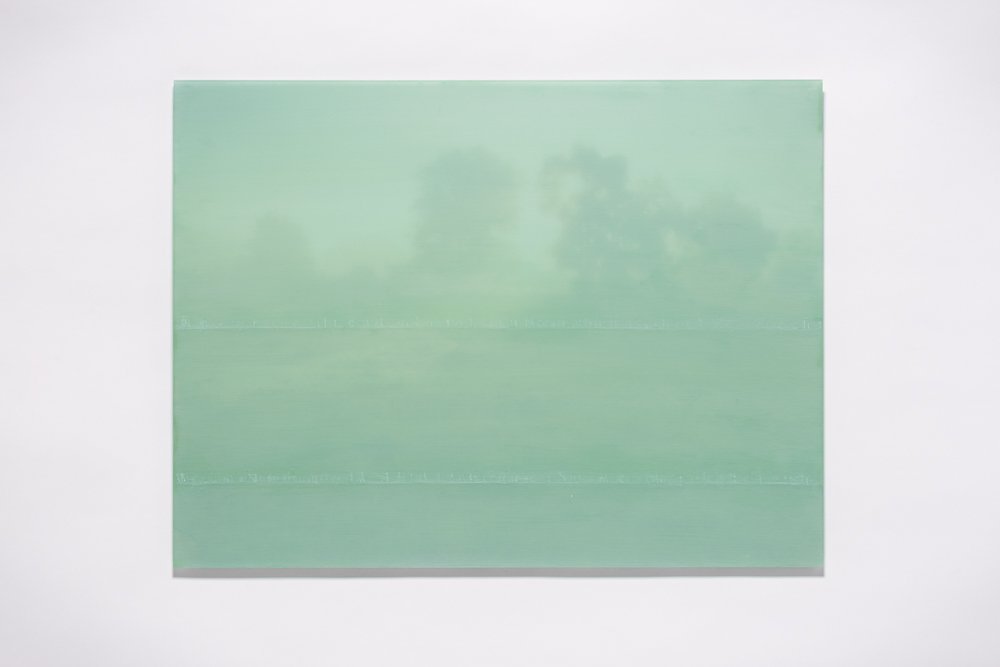
WALKING, 2021
Three paintings hold the trail like weather on a pane of glass. They carry celadon green and scraped silver, with letters that rise and sink in the light—white words you can read and ghost words you cannot, cut from the same sentences. The text comes straight from Oregon Trail letters, the real voices of people who went west and wrote home, their ink now turned to negative space and shimmer.
The work remembers what the road cost. Over twenty‑five years, some sixty‑five thousand people died out there, a grave about every fifty yards from Missouri to Oregon City, if you walked it off with your own feet. The paintings stand in that reckoning and ask, without sermon, why anyone would shoulder that risk for a horizon, and how that long, dangerous gamble still lives in the American nerve.
The surface is built and unbuilt in slow passes: paint and letters laid down, then sanded back; new layers brushed in, new lines pulled across, then thinned, torn, erased. The canvas becomes a palimpsest, a page written over so many times that all the old stories show through in faint, stubborn traces. Distorted, muted images of the trail hover there like memory half‑recalled, as if time itself had rubbed its thumb across the picture.
History and the present tense meet in these pieces. Old words, once folded into saddlebags and trunks, are pressed into modern materials and methods, making a surface that feels both fragile and enduring. The paintings offer not a map but a visitation: a way to stand still and feel the trail underfoot, its dust, its risk, and its long, unfinished imprint on the land and the country that grew around it.